Hangzhou Watch Company · China
Hangzhou ELA05MN
The ELA05MN is a Hangzhou micro-rotor automatic caliber, commonly associated with Hangzhou's 5000A/CAL5000A 5 Series.
The movement occupies a niche with almost no affordable competition: micro-rotor automatics at accessible price points. Swiss micro-rotor calibers have historically been the preserve of high-end manufactures. At 30 mm diameter and under 4 mm tall, the 5000A/ELA05MN enables genuinely slim dress-watch cases without the cost penalty of a Swiss movement.
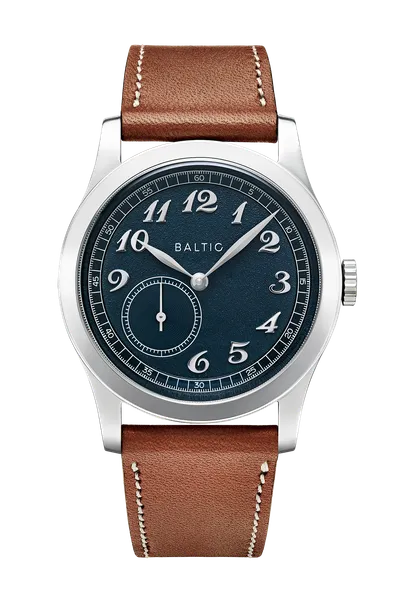
The caliber gained wider recognition when French microbrand Baltic chose it for the MR01 dress watch, launched in 2021. Reviews noted the movement's côtes de Genève finishing, perlage on the mainplate, and blued screws as unusually refined for a Chinese caliber at its price point.
Hz
Jewels
Reserve
In catalog
Technical specification
| Manufacturer | Hangzhou Watch Company |
| Origin | China |
| Type | Automatic |
| Beat rate | 28,800 bph · 4 Hz |
| Jewels | 30 |
| Power reserve | 42 h |
| Diameter | 30 mm |
| Hacking seconds | — |
| Hand-winding | — |
| Date | No |
| GMT | No |
| Chronograph | No |
| Accuracy (stated) | ±20 s/day |
1 model
Watches with this caliber
FAQ
Is the Hangzhou ELA05MN automatic or manual?
The Hangzhou ELA05MN is an automatic (self-winding) movement: a rotor winds the mainspring from the motion of your wrist, so it needs no battery.
What is the power reserve of the Hangzhou ELA05MN?
About 42 hours on a full wind — into a second day, so it keeps running overnight off the wrist. Power reserve is how long the Hangzhou ELA05MN keeps running once you stop wearing or winding it.
Does the Hangzhou ELA05MN have a date function?
No — the Hangzhou ELA05MN has no date complication, so every watch built on it runs a clean, date-free dial. That suits symmetrical and vintage-style designs, and means one less thing to reset whenever the movement is allowed to stop.
How accurate is the Hangzhou ELA05MN?
The Hangzhou ELA05MN is rated at ±20 s/day. That is a normal working range for an uncertified mechanical movement; a COSC-certified chronometer is held to a tighter −4/+6 s/day, and a watchmaker can usually regulate one closer. Real-world accuracy still depends on how each watch is regulated, worn, and serviced.
Spotted something wrong? Report a correction →